What to Wear to a Gym Where Every Wall Is a Mirror

Quick Answer: In a fully mirrored gym you will catch your own reflection constantly and involuntarily, so the outfit that works is the one that requires zero adjustment and gives you nothing to monitor. That means a top that stays put when you raise your arms, bottoms that stay opaque and in place through a squat, no waistband that needs pulling up, and hair fully secured. Fit and stability matter far more than coverage or colour.
You dressed for the workout. Then you got there, and there are mirrors on all four walls plus the ceiling column, and suddenly you are aware of a hem you had not thought about once in the changing room. The problem is not the outfit and it is not you - it is that mirrors turn every small instability into something you have to keep noticing.
Why does a mirrored room change the calculation?
Because it changes what your attention does, not what you look like.
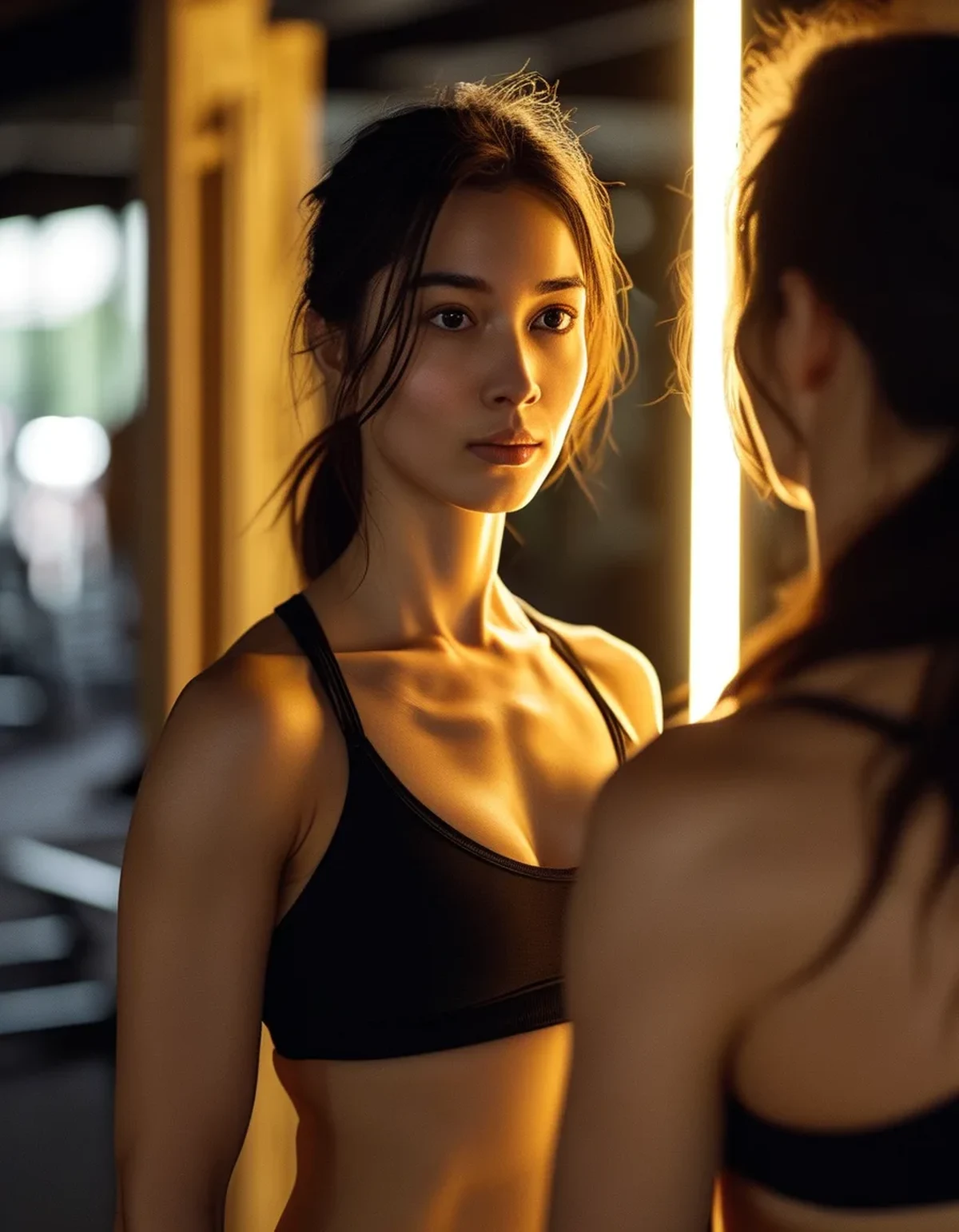
Reflection catches the eye involuntarily. Movement in peripheral vision draws attention automatically - it is a reflex, not a choice. In a room with mirrors on multiple walls, your own movement is constantly appearing in your periphery, and each time it does, a fraction of attention goes to it.
Anything unstable gets noticed repeatedly. A hem that rides up half an inch is invisible to everyone else and completely unremarkable in a normal room. In a mirrored room you see it, then you see it again, then you adjust it, and now you are adjusting it every four minutes for an hour.
The adjusting is what actually creates the discomfort. It is not the garment; it is the loop of notice-adjust-notice. Break the loop by removing the thing being noticed, and the mirrors become irrelevant within about two sessions.
There is a documented effect here too. Exercising in front of mirrors has been shown in several studies to increase self-focused attention and, in some people, reduce enjoyment and perceived energy - particularly among people who are newer to exercise. This is a real, measured phenomenon rather than a personal failing.
And the flip side is genuine: mirrors are useful for form. Once the outfit stops demanding attention, the mirror becomes a tool rather than a spotlight, and it is a good tool.
What does the outfit actually need to do?
Five things, all about stability rather than appearance.
Stay put when your arms go up. This is the single biggest one. Test it before you leave the house: raise both arms fully overhead and check whether the hem lifts. If it does, either the top is too short or too fitted at the hip. A top that stays down through an overhead press is a top you will never think about.
Stay opaque under load. Squat down in front of a mirror at home in good light. Fabric thins under stretch, and light-coloured or thin technical knits can go translucent at exactly the moment they are most stretched. This is the one that people discover in the gym rather than at home, which is the worst possible order.
Stay up without a waistband adjustment. A high-rise waistband that grips, or a drawcord, or both. Anything that slides down during a set becomes a permanent low-level task.
Keep hair completely out of the way. Loose strands falling forward during a set create exactly the same notice-adjust loop as a hem. Secure it properly - not a loose bun that will half-fall on the third exercise.
Have no straps that shift. A bra strap that slides off the shoulder during overhead work is a small thing and it is a small thing thirty times an hour. Racerback or crossback designs solve it structurally.
Notably not on the list: how much skin is covered, what colour it is, whether it is new, or whether it matches. None of those affect the attention loop at all.
What Nobody Tells You About Mirrored Gyms
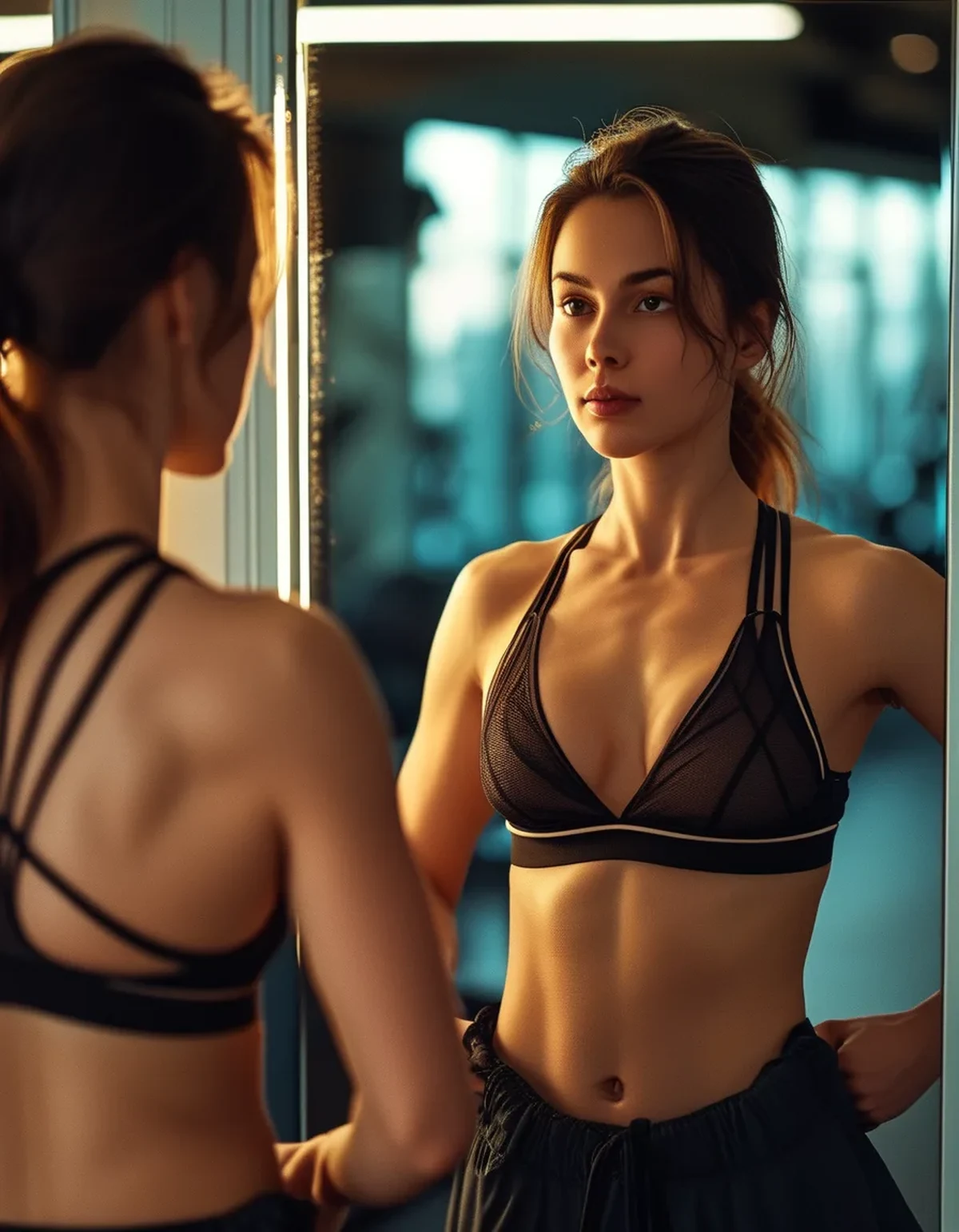
Everyone is looking at themselves, and it is not vanity. The mirror in a weight room is a form-checking tool, and the people who look most confident in front of it are usually checking their bar path or their knee position. Understanding this reframes the entire room within about a week, because it turns out almost nobody has spare attention for anyone else.
Where you stand changes everything. You do not have to face a mirror. Most gyms have a corner, a wall of machines, or a functional area with no mirror coverage. Choosing to work with your back to the room is completely normal and nobody notices which way you were facing.
Dark, matte, mid-tone fabrics are the practical choice, and not for the reason people assume. It is not about looking slimmer. Matte fabrics do not catch light and flash in the mirror as you move, which means less peripheral movement drawing your attention. Shiny fabrics genuinely do register more.
The second session is dramatically easier than the first. Novelty is a large part of what makes mirrors uncomfortable, and it fades fast. Almost everyone reports the mirrors becoming background by session three or four.
A phone in a pocket ruins everything. It swings, it pulls the waistband down, it slaps against your leg, and every one of those events is a notice-adjust event. Leave it in a locker or use an armband.
And headphones do more than play music. Narrowing your auditory attention narrows overall attention, which reduces how much of the room you are processing. It is one of the most effective anti-self-consciousness tools available and it is entirely socially normal.
A build that requires zero adjustment
Bottom: high-rise, mid-weight, dark, squat-tested. At least a 25cm rise, a wide waistband that grips without digging, and a fabric substantial enough that it does not thin under stretch. Full length or 7/8 length - both are stable; very short shorts require more adjustment for most people and cycling-length shorts are the more stable of the short options. The at-home squat-in-front-of-a-mirror test takes ten seconds and settles this permanently.
Top: fitted or semi-fitted, long enough to stay down overhead. A hem that sits two to three inches below the waistband is the range that survives an overhead reach. Loose crop tops are the most common source of the notice-adjust loop; if you want a shorter length, a fitted one that grips at the hem is far more stable than a loose one.
Bra: racerback or crossback, correctly sized, no adjustment straps that slip. High impact if you are running or jumping, medium for lifting. Straps that stay on shoulders during overhead movement are the specific requirement.
Hair: fully secured, twice if needed. A tie plus a clip, or a braid. The goal is not touching it once during the session.
Shoes: flat and stable for lifting, cushioned for cardio. Not a style consideration but a stability one, and stable feet reduce wobble, which reduces movement in the mirror.
Nothing in pockets. Phone in a locker or an armband, keys in a locker.
And a genuinely useful trick for the first few sessions: wear something you have already worn for a walk or a class. Familiar clothing has already passed every stability test, and the first gym session is not the moment to find out how a new top behaves overhead.
FAQ: Mirrored Gym Outfit Questions, Answered
What should I wear to a gym with lots of mirrors?
Something that requires zero adjustment - a top long enough to stay down when your arms go overhead, high-rise bottoms in a fabric that stays opaque through a squat, a racerback bra, and fully secured hair. Stability matters far more than coverage or colour.
How do I stop feeling self-conscious in a mirrored gym?
Remove the things that repeatedly draw your attention - an unstable hem, a sliding waistband, loose hair - then choose a spot facing away from a mirror and use headphones. Self-consciousness in mirrored gyms is a documented effect, not a personal failing, and it fades substantially by the third or fourth session.
How do I check if leggings go see-through?
Squat fully in front of a mirror at home in bright light, ideally with a phone camera or a second angle. Fabric thins under stretch, so the test has to be done at full stretch rather than standing. Doing it at home rather than at the gym is the entire point.
Are gym mirrors actually useful?
Yes - they are the most accessible form-checking tool available, particularly for bar path, knee tracking, and back position. Once your outfit stops demanding attention, the mirror shifts from being a spotlight to being an instrument, which is what it is there for.
TL;DR:
- Mirrors make small instabilities into repeated distractions - fix the instability, not the mirror.
- Test overhead reach and a full squat at home, in good light, before the first session.
- High rise, fitted top two to three inches past the waistband, racerback bra, secured hair.
- Matte fabrics catch less light and draw less peripheral attention than shiny ones.
- Nothing in pockets, headphones on, and stand facing whichever way you like.
Everyone at the mirror is checking their own knee position. Give yourself nothing to adjust and you will be doing the same thing by Thursday.
See It in Motion
Seen here: Crewneck Short Sleeve Workout T-Shirt — shop it on bubblelime.com
Keep Reading
This article is for general informational and styling purposes only. Fit, sizing, and product availability may vary.